


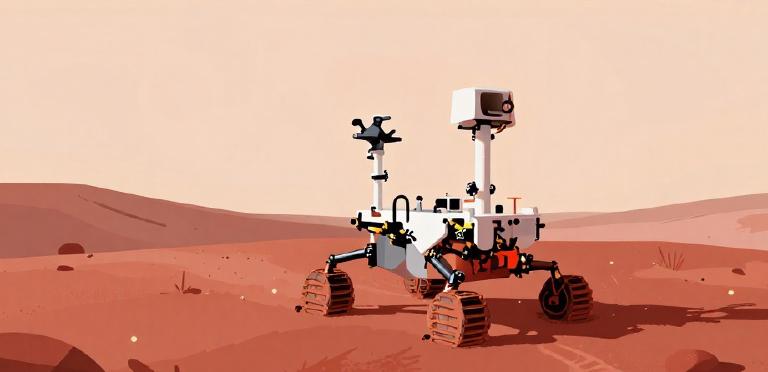
A few days ago I read news that left me thinking for a while. It’s not the first time I’ve heard about AI in space, but it is the first time I’ve read about Claude planning routes on Mars. And the best part: it worked.
NASA has been using Anthropic’s Claude to plan the Perseverance rover’s routes on Mars. Yes, you read that right: a generative language model generating navigation routes for a rover that’s 225 million kilometers away.
The Problem: Planning Routes on Mars is Tedious
To understand why this is interesting, you have to understand the problem. Mars’s surface is treacherous. No one wants to be responsible for getting a billions-of-dollars rover stuck in the sand, as happened to the Spirit rover in 2009.
So Perseverance’s team spends considerable time planning routes. This involves:
- Consulting orbital Mars images
- Analyzing terrain to identify hazards
- Establishing waypoints to guide movement
- Transmitting data 225 million kilometers
- Praying nothing was missed
The Solution: Claude as Navigator
JPL researchers decided to let Claude - using its vision capabilities - have its chance. And Claude did what Claude does best: analyzing data and generating structured results.
What Claude did:
- Analyzed high-resolution orbital images from HiRISE
- Processed terrain data from digital elevation models
- Identified critical terrain features: bedrock, outcrops, dangerous rock fields, sand ripples
- Generated a continuous route with complete waypoints
- All in Rover Markup Language (RML), which is basically XML
The Interesting Part: Humans in the Loop
Here’s where the story gets good. Because Claude didn’t do it all alone. JPL engineers did exactly what any sensible person would do when programming rovers on other planets: verify everything.
Using a simulator representing a virtual replica of the rover, engineers reviewed more than 500,000 telemetry variables about the rover’s projected position and potential obstacles. And they made corrections.
The best part: when engineers reviewed Claude’s plans, they found only minor changes were needed. The ground-level camera images (which Claude hadn’t seen) gave a clearer view of sand ripples in a narrow corridor, so drivers divided the route more precisely. But beyond that, the route held up well.
The Result: 400 Meters on Mars
On Martian days (sols) 1,707 and 1,709, corresponding to December 8 and 10, 2025, Perseverance executed routes planned by AI instead of humans. The rover traveled about 400 meters based on an AI-generated route.
And it worked. NASA shows an orbital image where you can see the AI-planned route (in magenta) and the actual route (in orange). They’re not exactly identical - the rover’s AutoNav made real-time decisions - but the base route was solid.
Why This Matters
What fascinates me most about this milestone isn’t just the technical feat - which it is - but what it represents:
1. AI in Critical Environments
We’re not talking about generating text for marketing or summarizing documents. We’re talking about navigating a billions-of-dollars rover on Mars. The confidence this requires is enormous.
2. The Approach is Responsible
NASA didn’t give Claude the keys and say “do whatever you want.” There was exhaustive human verification. There was simulation. There was validation. It’s exactly the approach I like: AI amplifying human capabilities, not replacing them.
3. Real Time Savings
According to Anthropic, JPL engineers say Claude can reduce route planning time by half. They don’t specify how long that “half” is, but if you know what it takes to plan space missions, you know any savings is significant.
Personal Reflections
What I like most about this story is that it represents exactly the type of AI application that excites me: AI working on real problems, with responsible human supervision, generating tangible value.
It’s not hype. It’s not “AI will replace NASA engineers.” It’s “AI is helping NASA engineers do their job more efficiently and focus on what matters.”
Claude didn’t replace anyone. Claude did the tedious work of analyzing orbital images and generating waypoints. Humans did what they do best: verify, validate, and make responsible decisions.



Comments