This Friday, at our “backend bi-weekly”, we spent several hours talking about AI and how it will affect us in the future: whether it will change our jobs (not as some grim hypothetical, but as a short-term reality), how hard it will be for newcomers to get into the industry, low quality in exchange for speed (the old joke of “it’s not a bug, it’s a feature”)… All of it described something very sad and bleak, a deserted wasteland with tumbleweeds rolling by and nobody in sight.
My take was more positive, because of how I use AI day to day. For me it’s like an “intern” I give clear, concrete tasks to, tasks that would take me a long time and that are more mechanical than thoughtful. I think it through, reason about it, lay it out and ask very clearly for what needs to be done, and then, as with any intern, I supervise. Something I already touched on when I wrote that AI agents write more code, but companies aren’t shipping more software.
I know what I do will keep changing and that in many things I’ll be replaceable, but I also know that for what I consider essential I’ll always be there, either doing it by hand or checking that it’s what I expect and how I would have done it myself.
I don’t see it as something apocalyptic, but as a paradigm shift, one more in over three decades in this world, where the goal has always been the same: automating things with computers. The only thing that changed were the tools to do it: languages, databases, libraries, protocols, communications…
The watercolours
And lo and behold, a day later I came across an analogy for all this and for the “fantasy mode” AI gives us. To switch off for a bit, I decided to try painting with watercolours. What could go wrong? Nothing… I know colours and combinations, I’ve used brushes now and then, I’m good at drawing with pencil and ink, and I have perspective and light more than “mastered”. So I bought several watercolour sets, several sets of brushes, assorted extras (natural sponges, palette knives…) and dived into tutorials and a couple of books: everything needed to show off my mastery. I already had the knowledge and the materials (and this is where having AI as the executor comes in).
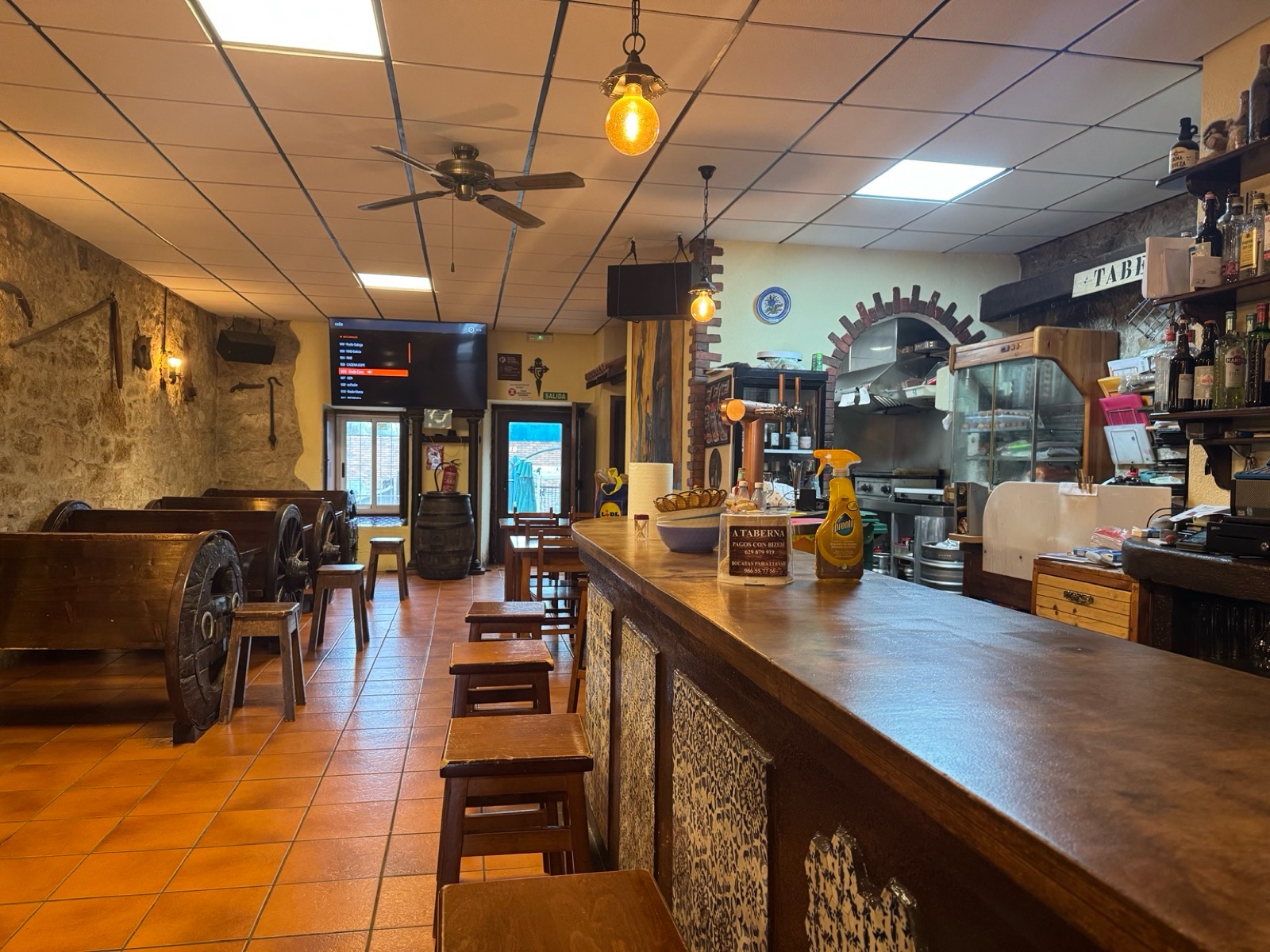
The initial goal: to paint in watercolour an image I see very often, a bar in my village. A nice challenge because of the lighting and the perspective. So, let’s get to it.
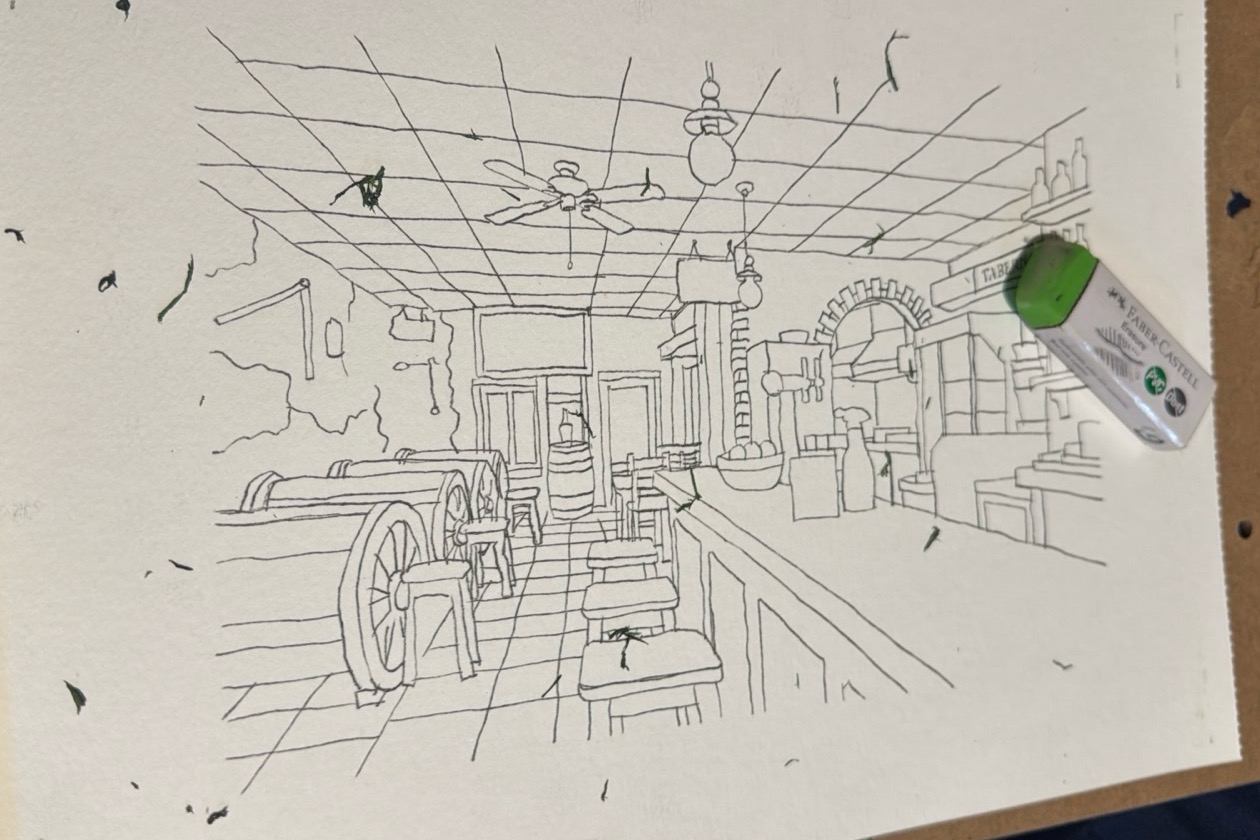
With my usual meticulousness I drew the lines, going for a sketch style that would serve as the base for the watercolour. I wasn’t after perfection, just something correct for what I had in my head.
Carefully following everything I’d read, I taped the 300 gsm paper to a board with masking tape and I was the happiest man in the world: my watercolour box, my premium synthetic squirrel-hair brushes, my little cups of water and the skill I thought I had… Everything was going to flow.
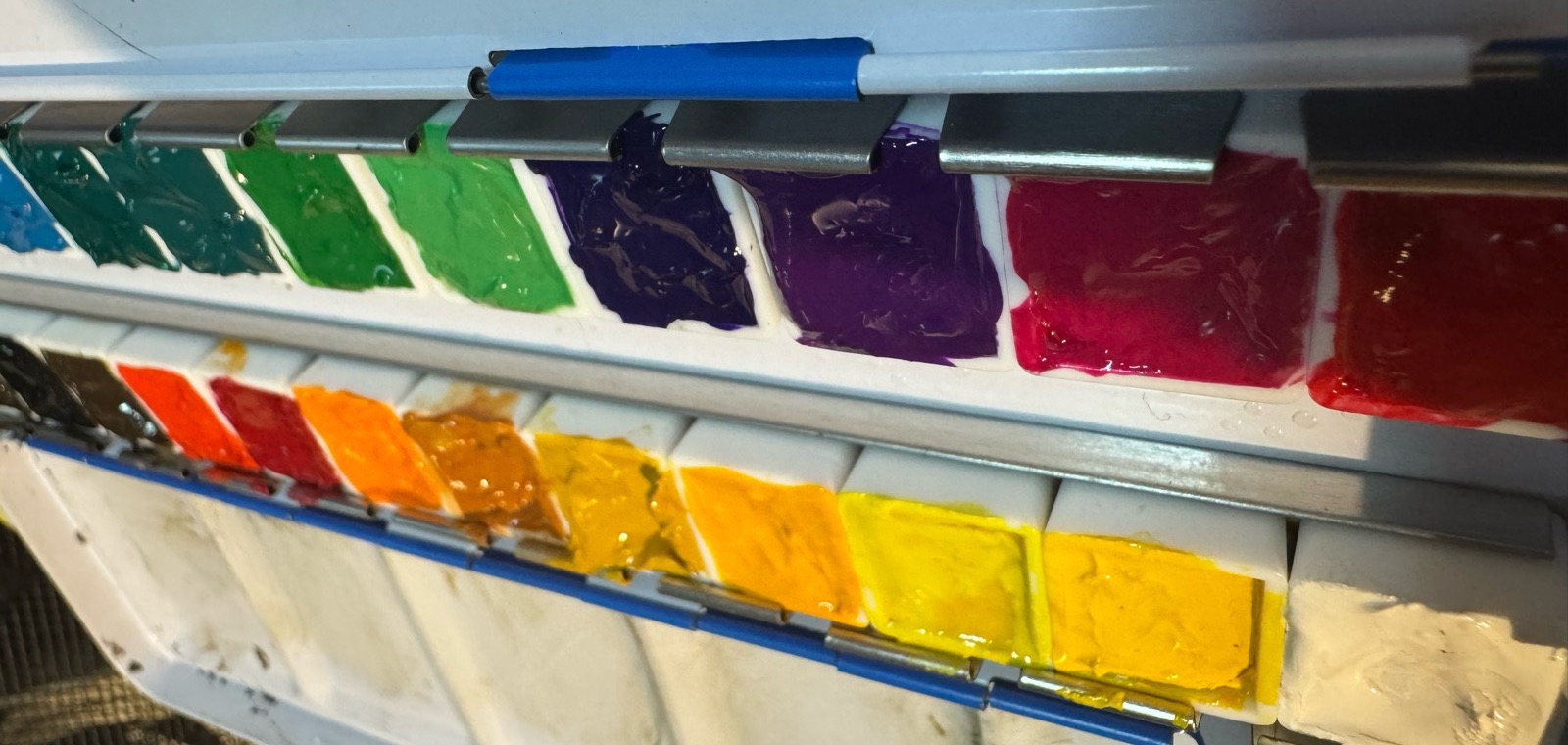
The day before I had filled the half pans (a concept and an object I didn’t know about) with tube watercolour, meticulous and tidy, to the point of making a document with the names of the colours.
And then came the surprise: how on earth do you use watercolour, how do you handle the brushes and the water? That’s where I fell into the madness of not really knowing how to use it. I knew the theory: in watercolour there’s no white, the white is the paper; the pigments aren’t opaque, you work layer upon layer and saturation is the end point. But knowing it didn’t matter, because I simply didn’t know how to lift the pigment and work it before it reached the paper. It was obvious, but for me it was the least relevant part. What mattered was how to get effects with sponges, sea salt…, the colours and their mixes. And the reality is that I was missing the most basic thing. It’s like reading and memorising a driving manual without ever having started a car.
A step back
This is how things stood when I realised my limitations:
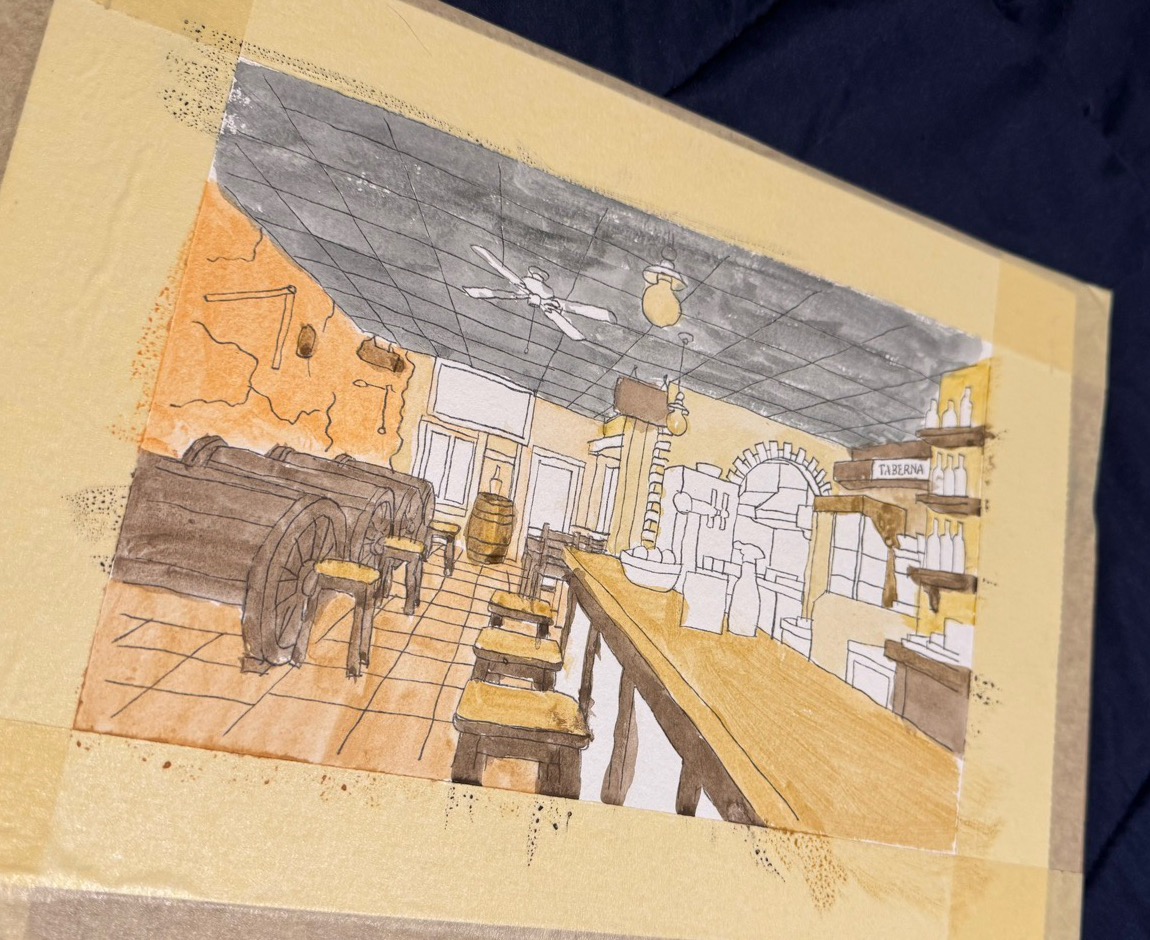
There was no point carrying on: I had to go back to basics to really be able to solve it. No problem, what I was doing gets parked. I might have to throw it away, or not, but now isn’t the time to decide. Time to put my foot down and go back to basics. Am I embarrassed to admit it? Not at all, because I’m clear about the goal, but to get what I want I need a minimum foundation that I skipped, believing that knowing about it was more than enough.
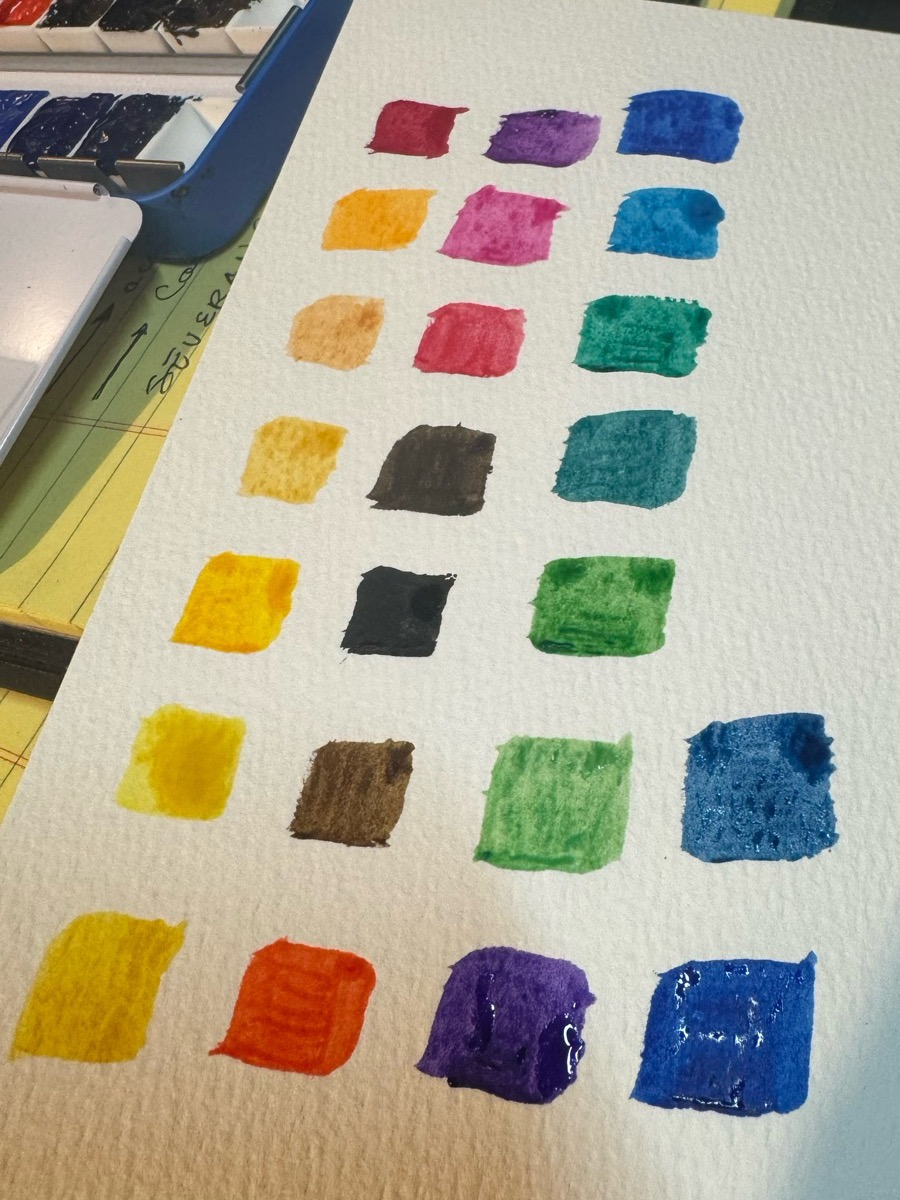
The little step back ended up like this: stopping and “wasting time” (although I don’t consider it wasting time) to gain real experience with the materials before doing even the simplest thing. Starting with learning to use the pigments and moving on to mixes, layers, order, glazes… Nothing theoretical, all 100% hands-on.
So what does this have to do with AI
This is like trying to get the most out of AI without knowing or having touched its guts. I could have switched to something I do control, like acrylics or tempera (which now apparently go by gouache), which are opaque, but I liked the transparency and the challenge. So no: I’m going to get there, with some prior and necessary work. That prior and necessary work is what we really need to do before AI solves things for us. How much is needed? In my experience, a lot, because only then do you really know the quality and the quirks of what’s being solved for you.
For all intents and purposes, realising you don’t understand the code AI has generated is the same as discovering that what you thought was trivial and basic (brush, water and pigments) wasn’t even on your list of priorities. Who knows how the story ends, but however it ends, you won’t want to be anywhere near it.